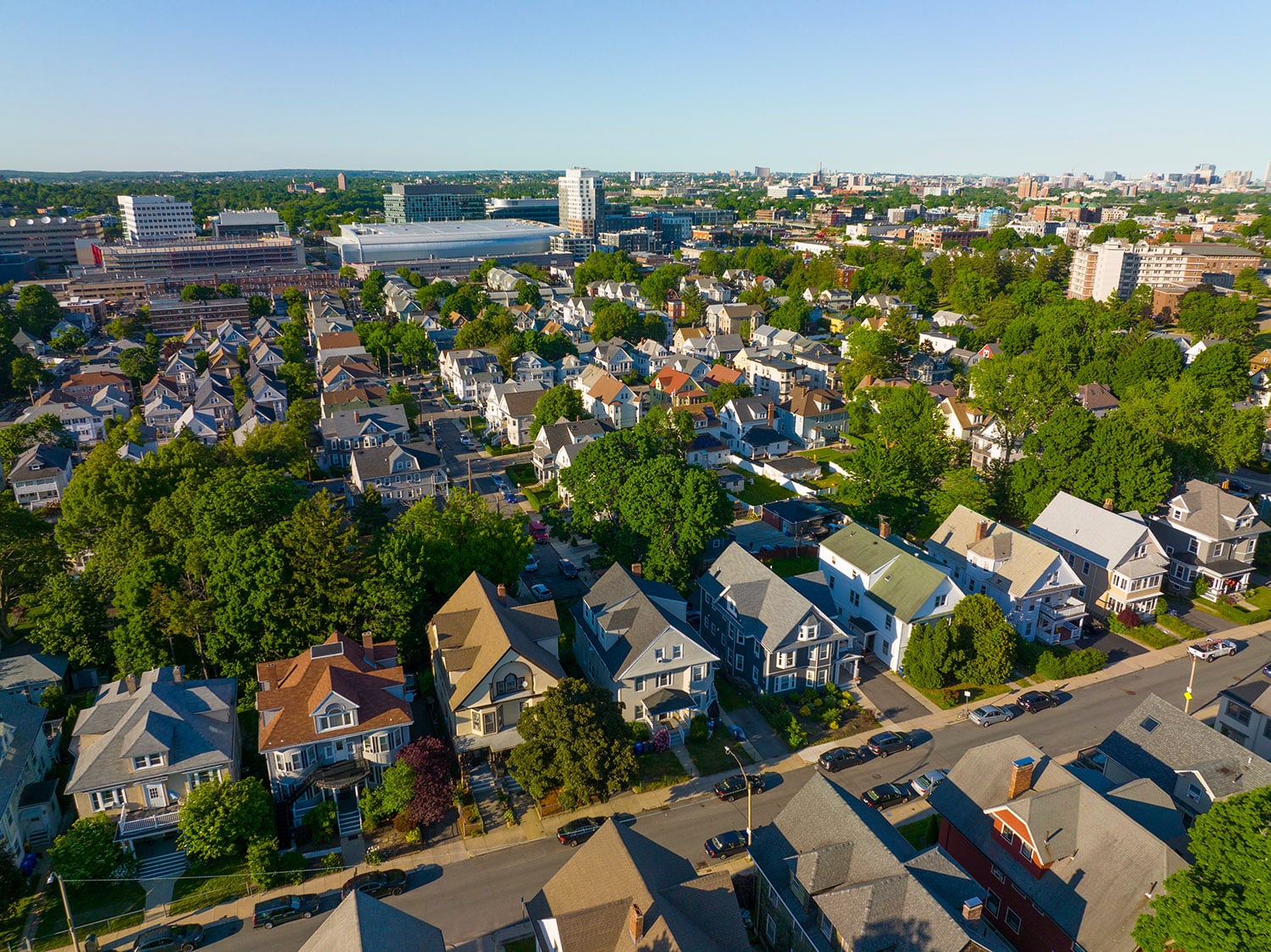
In April 2026, Boston City Councilors Sharon Durkan and Henry Santana filed a 35-page text amendment to the Boston Zoning Code that would eliminate off-street parking minimums for all new residential construction across all 23 neighborhoods, amending the base zoning code and every neighborhood article. A public hearing followed in June.
Boston has had parking minimums since the 1950s and has never attempted to remove them citywide. Five years ago the Council eliminated them for affordable housing developments specifically. This goes considerably further.
Whatever you think of it, it has a direct effect on property values — and most of the commentary has the direction backwards.
What a parking minimum is, and why it affects housing cost
A parking minimum requires a developer to build a set number of spaces per unit. Structured parking is expensive, so the requirement adds cost to every unit — and on smaller multifamily projects it can be the line that makes a deal fail underwriting entirely.
The filing frames it exactly that way: stripping out per-unit ratios that date back decades in order to lower per-unit costs and unlock smaller multifamily projects.
The local precedent
Cambridge eliminated all residential parking minimums in 2022. Somerville followed in 2024. In both cities, car ownership and on-street parking conditions have remained stable.
That is the empirical answer to the obvious objection, and it is worth more than either side's rhetoric.
Elsewhere: in Seattle and Buffalo, researchers found that 60 to 70 percent of new homes built after reform would have been illegal to construct under the old rules. Austin and Seattle have made the change; New York's City of Yes created three zones — one where restrictions largely remained, one where minimums were reduced, and one where they were erased.
The opposition is not frivolous
The Wu administration has been outspokenly opposed, and councilors have asked how the city would protect residents who rely on cars. In a city where on-street parking is already scarce and winter compresses it further, that is a fair question rather than a reflexive one.
The process runs through the Council's planning committee, then a full Council vote, then the BPDA and the Boston Zoning Commission. It is not decided.
The property-value read, which people get backwards
The instinct is: less required parking means parking matters less, so my space is worth less.
The opposite is more likely. If new buildings build less parking, the existing supply of deeded spaces becomes scarcer relative to the number of households. Scarcity in a fixed-supply asset with rising demand does not push prices down.
A deeded parking space in the South End, on Beacon Hill, or in the North End already carries real value independent of the unit it is attached to — frequently with its own deed and its own assessed value. Reform that reduces future supply is, if anything, supportive of that value.
The more meaningful effect is on new construction pricing: units in new buildings without parking should price below comparable units with it, widening the spread between parked and unparked inventory. That spread is where the opportunity is, in both directions.
The four things that get called "parking" and are worth different amounts
This matters more than the policy fight, and it costs buyers money every week.
Deeded space. Real property. Often its own deed and assessed value, transfers with the sale, and in some buildings can be sold separately. This is an asset.
Assigned space. A common element the association has allocated to your unit under its rules. Usually transfers — but read the documents, because rules govern it and rules can change.
Rented space. A monthly contract, often with a neighbor or a nearby garage. It can end.
Resident permit. Not a space at all. Permission to look for one on the street.
All four get described identically in listings. In the South End or on Beacon Hill, the difference between the first and the last can be a six-figure difference in value. Ask which one, and get the answer in the documents rather than at the showing.
Tandem parking deserves its own warning
Tandem means two cars in a line. If both spaces are yours and you have two cars, fine. If you share the arrangement with another unit, you are coordinating departures with a neighbor for years, and verbal parking agreements between units are among the most reliable sources of ongoing friction in Boston condominiums. Get the arrangement in writing before you close.
And the winter rules, since they are part of what parking means here
Space savers are legal only during a declared snow emergency and for 48 hours after it ends, after which Public Works can collect and discard them. They are banned at all times in the South End and Bay Village. When a snow emergency is declared, every vehicle on a posted snow emergency artery gets towed — not ticketed.
If a property has no off-street parking and sits on a posted artery, you are relocating your car on short notice several times a winter. That is a property characteristic, not a detail.
What to do
If you own a deeded space: know its assessed value separately from your unit, and do not let an agent bundle it invisibly into a listing price. It is a line item.
If you are buying: establish which of the four categories applies, in writing, before your contingency dates pass.
If you are watching the policy: the thing to track is the BPDA and Zoning Commission stage, not the Council vote. That is where it becomes real.
Send me a property you are considering and I will tell you exactly what kind of parking it has, what that is worth in that neighborhood, and what the winter situation on that street actually looks like.
Chris Remmes, Managing Broker, Remmes & Co. [email protected] | 617-398-0015
Check out this article next