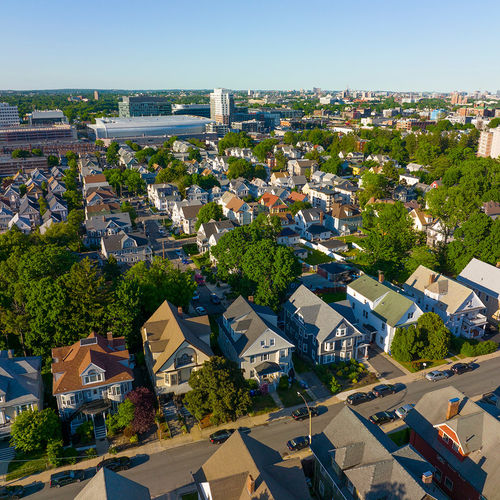
Boston drivers lost 83 hours to congestion in 2025 — four hours worse than the prior year, at a cost of about $1,529 per driver. The city ranks fifth worst in the nation and twelfth worst in the world, ahead of Bangkok, Rome, and Melbourne.
That is the number people quote. Here is the number that should actually change your house search.
The corridor problem
The single worst stretch is I-93 southbound between Causeway Street and Pilgrims Highway at rush hour — the eighth busiest corridor in the entire country. Drivers who make that trip every weekday at peak lose roughly 81 hours a year on that segment alone.
Eighty-one hours is two full work weeks. If that is your commute, the citywide average does not describe your life; the corridor does.
So the first question in evaluating any property is not "how far is it." It is which corridor am I on, and at what hour.
The trend is better than the reputation
Worth knowing before you panic:
- 2019: over 149 hours lost, and INRIX named Boston the worst city in the country for the second year running
- 2022: 134 hours, fourth worst in the world
- 2024: 79 hours, down from 88 — a 10 percent drop, the largest of any of the top 25 most congested U.S. cities
- 2025: 83 hours, fifth worst nationally
MassDOT attributed the 2024 improvement to optimized traffic signals, dedicated bus lanes, transit enhancements, more biking and walking, and commuters adjusting schedules.
Then it ticked back up, which tracks the national pattern — the average U.S. driver lost 49 hours in 2025, six hours worse than the year before, as return-to-office continued. Nationally, commuting by car is nearly back to pre-pandemic levels while public transit ridership remains down about 22 percent from 2019.
The honest summary: structurally bad, incrementally improving, partially offset by more people driving to offices again.
What changed on the transit side, which is the actual lever
You do not solve congestion by adding lanes in a city laid out in the 1600s. You solve it by making not-driving viable.
In September 2023, 36 miles of track across all four subway lines — more than a third of the network — carried speed restrictions. 191 slow zones. The agency committed to removing all of them by the end of 2024 and did: 188 days of planned disruptions, shutdowns ranging from four to twenty-one days, fourteen months of work, finishing on the Green Line. The Red Line ran restriction-free end to end for the first time in probably over fifteen years. The state estimated roughly two million rider minutes returned per day, collectively.
Add the Green Line Extension — 4.3 miles, $2.28 billion, stations at Union Square, East Somerville, Gilman Square, Magoun Square, and Ball Square, projected at around 45,000 one-way trips a day by 2030.
If you have not reconsidered transit-oriented buying since 2023, your information is out of date in a way that directly affects which neighborhoods make sense for you.
How to price a commute into a purchase
1. Identify the corridor, not the distance. Two houses equidistant from downtown can sit on completely different corridors. Southbound 93 at 5 p.m. is a different asset than a Red Line walk.
2. Drive it at the real hour, twice. Tuesday at 8 a.m. and Thursday at 5:30 p.m. Not Sunday afternoon, when every commute in Massachusetts looks fine.
3. Walk the transit route with a timer. A listing that says "near the Green Line" covers both a four-minute walk and a twenty-two-minute one. In February that difference decides whether you use the train or buy a second car.
4. Convert hours to dollars. Eighty-one hours on 93 at your own hourly value, plus fuel, plus the maintenance of those miles. Then compare that against the price difference between the two properties you are weighing. Frequently the closer property is cheaper in total.
5. Price the second car. Two cars fully loaded — payment, insurance at suburban rates, fuel, maintenance, depreciation — is a large annual number that never appears in a housing comparison. A property where one car works, or none, has a financial advantage most buyers never count.
The buyers who get this most wrong
People relocating from car-dependent metros, who assume a 25-mile commute here resembles a 25-mile commute there. It does not.
People buying for space, who find the square footage they wanted and absorb a corridor commute to get it. Sometimes that is the right trade. It should be a decision, not a discovery.
People who tour on weekends, which is nearly everyone.
Send me two addresses you are weighing and I will tell you what corridor each one puts you on, what the honest transit walk is, and what the commute difference is worth in dollars over five years.
Chris Remmes, Managing Broker, Remmes & Co. [email protected] | 617-398-0015
Check out this article next